Automatic feed distributionAutomatic feed distribution
A complete route from silo to cage trough or floor pan. The line is selected by row length, tier count, feed form, target delivery time and cleaning access.
A complete route from silo to cage trough or floor pan. The line is selected by row length, tier count, feed form, target delivery time and cleaning access.
01
Distribution
Trolley or auger movement aims for a consistent fill along long rows; a feed-level check at both ends is essential.
02
Feed access
Trough shape and edge are selected for bird stage and to limit feed throwing.
03
Upstream connection
Silo, main line, hopper, end stop and controller are specified as one package.
02 / Equipment details
See each equipment detail in context.
Each catalogue image explains a visible structure or process; pictured configurations are not a fixed supply list.
Product catalogue visual / 01
01 / Equipment details
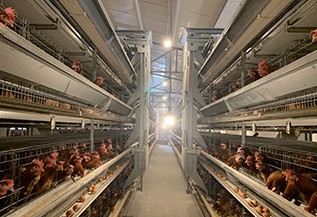
Traveling feed trolley
The source shows a traveling feeder alongside tier troughs. Trolley and hopper configuration follow row length, tier count and feed characteristics.
Configure for your site:Check rails, end stops and travel obstructions.
Product catalogue visual / 02
02 / Equipment details
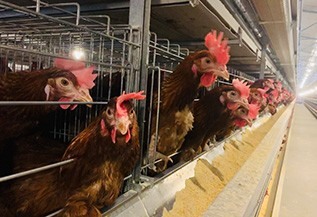
Continuous trough access
The close-up shows birds feeding at a continuous trough. It illustrates placement and reach; feed distribution and leftovers still require verification with the selected trolley.
Configure for your site:Confirm trough lip, feeding height and cleaning.
Product catalogue visual / 03
03 / Equipment details
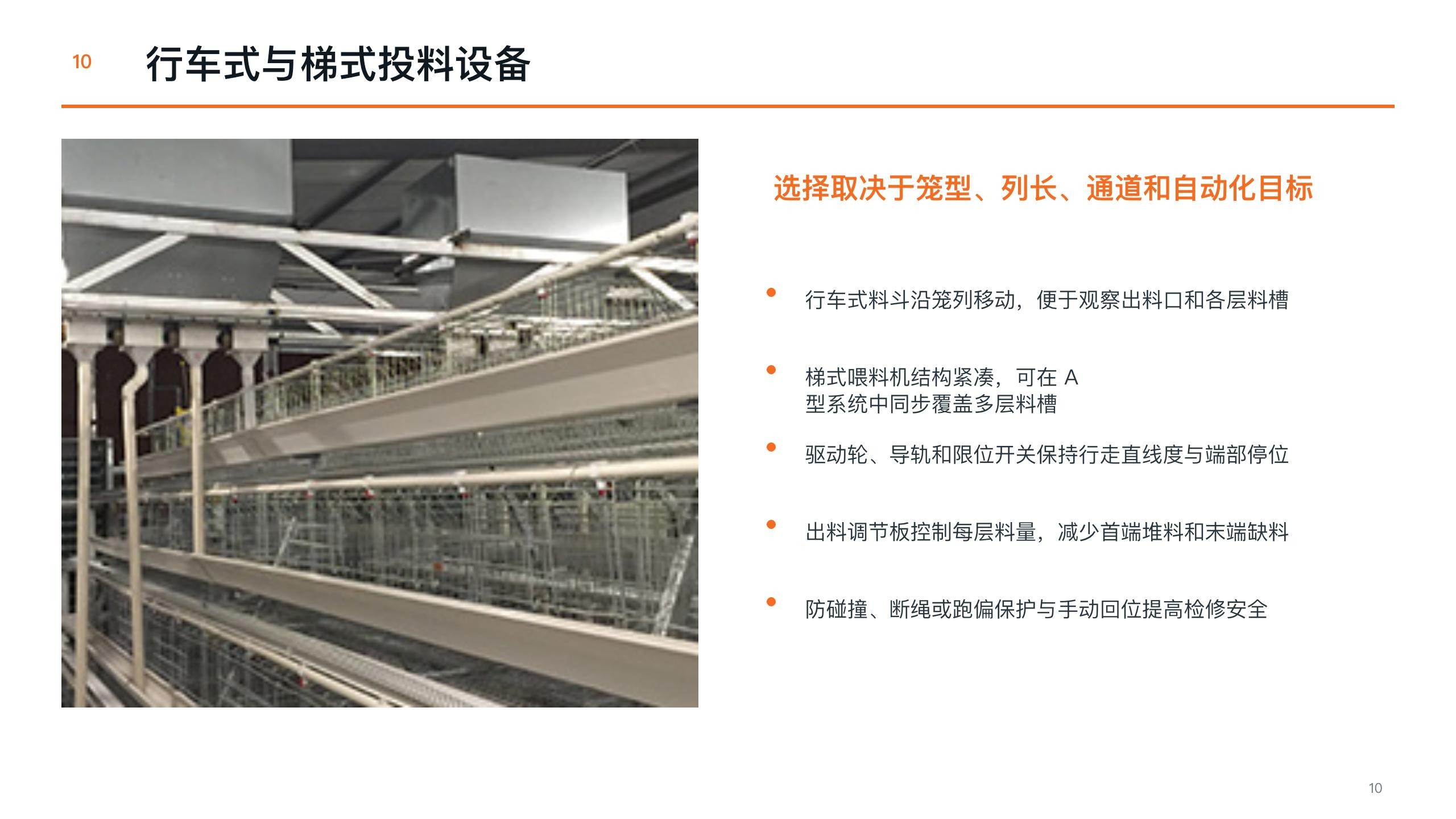
Trolley and stepped feed reference
The source page shows another feeding arrangement as a configuration option. It must not be combined automatically with the preceding photos as one model or supply list.
Configure for your site:State the selected trolley, stepped or other feeder in the quotation.
03 / System connections
How the equipment connects.
Functional connection map · not a construction drawing
01
Main feed line
Bring feed from storage to house equipment.
→
02
Trolley or hopper
Distribute feed along selected cage rows.
→
03
Tier troughs
Keep feed reachable and observable.
06 / Configuration scope
Turn a product family into a project specification.
Final model and supply scope are set in a written project specification.